Content Update SEO Strategy

Does Updating Old Blog Posts Improve SEO Rankings?

Do you need more content, or just better updates to rank higher on Google?


Short Answer: Do Content Updates Help SEO Rankings?

Yes. Updating content can help SEO rankings. But only if the update actually improves the page.

Changing the date or adding a few sentences usually does nothing. Search engines care more about whether the page answers the question better than before.

If an update makes the content clearer, more accurate, or easier to read, it can help the page show up more in search results. This often means fixing outdated info, tightening the topic, or improving how the page is structured.

What You’ll Learn in This Guide

Why Old Blog Posts Stop Ranking Over Time

Laptop showing an archived SEO article next to a phone with modern content, representing how outdated blog posts lose rankings over time

Most blog posts don’t suddenly drop off Google. They slowly get pushed down as things change.

● Information becomes outdated

What worked or made sense a few years ago may no longer match how things are done today. Even small outdated details can make a page feel less useful.

● Search intent changes

People still search for the same topics, but they expect different answers. A post can be well written and still miss what users are actually looking for now.

● Competitors step in

Newer posts often explain the same topic in a clearer or more complete way. Over time, those pages earn the spots older content used to hold.

● People engage less

When users click less or leave faster, it usually means the page is no longer helping as much as it once did.

How Updating Old Content Helps SEO

Laptop displaying a refreshed blog article with improved layout and clarity, demonstrating how updating old content helps SEO

Updating old content helps when the page becomes more useful than it was before.

● The page fits the search better

The topic stays the same, but the words and focus match how people search today. Small changes can help the page answer the
question more clearly.

● More people click the result

A clearer title or description makes it easier for people to choose your page. When more people click, the page has a better chance to move up.

● The page connects to other pages on your site

Adding or fixing links helps your pages support each other. It also makes it easier for search engines to understand what your site is about.

● The page looks active, not forgotten

Content that gets real updates feels more trustworthy. Pages that are clearly maintained tend to perform better than pages left untouched for years.

Which Blog Posts Are Worth Updating First

Laptop showing content analytics and page performance data on a desk, highlighting how to prioritize blog posts for updates

Not every blog post is worth touching. Some are just better targets than others.

● Posts that sit close to page one

These pages are already doing something right. They just need a small push. A few fixes can move them up faster than writing a new post from scratch.

● Posts that show up a lot but don’t get clicks

If a page appears in search but people skip it, something is off. Most of the time, it’s the title or how the result looks. These are easy wins.

● Posts that slowly lost traffic

A slow drop usually means the post got left behind. The topic still matters, but the page needs cleanup. Updating it can bring some of that traffic back.

Content Refresh vs Full Rewrite: What’s the Better Move?

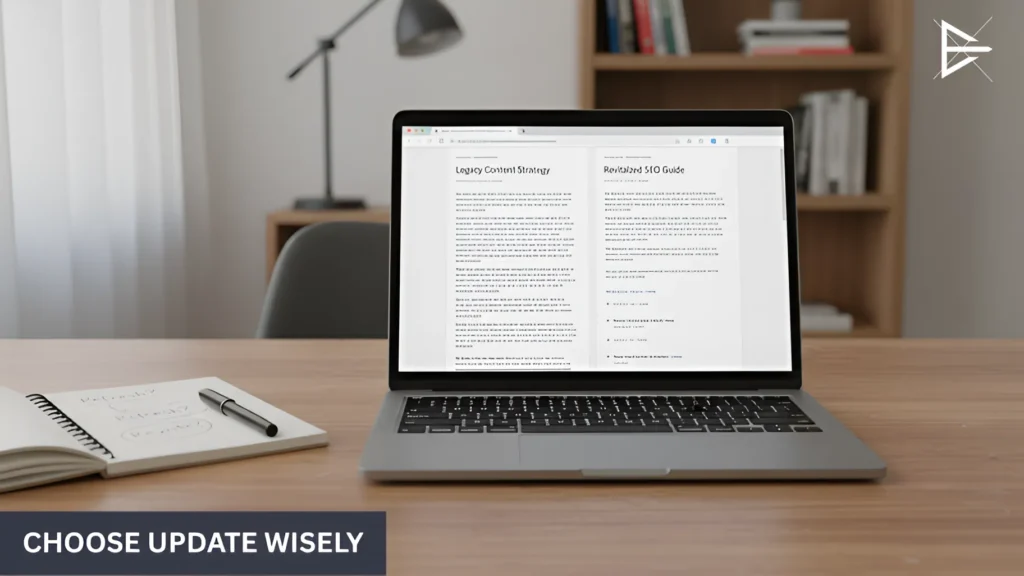
Laptop displaying two versions of a blog article side by side, showing the decision between content refresh and full rewrite

After you pick a page to work on, the next question is simple. Do you fix what is there, or do you start over?

A refresh usually makes sense when the topic still matters. The page already shows up in search, even if it is not where you want it. The layout is fine, but some parts feel old, unclear, or rushed. In this case, cleaning things up can be enough. You keep what works and fix what does not.

A full rewrite is a better move when the page no longer fits what people search for. Sometimes the topic has changed. Sometimes the content is too short or missing key points. Other times, better pages exist and clearly do a stronger job. When that happens, small edits rarely help.

If you are not sure which path to take, start with a refresh. It takes less time and carries less risk. If the page still does not improve, that is usually a sign it needs more than light changes.

What to Update (and What to Leave Alone)

Laptop showing selective content refinement on a blog page, illustrating focused updates to improve weak sections of content

When you update a post, you do not need to touch everything. In fact, changing too much is often the problem.

What to update:

● Titles and meta descriptions. This is the first thing people see in search. If it does not clearly say what the page is about, people skip it. Small changes here can bring more clicks.

● Old or wrong information. If something feels dated, it probably is. Old examples, tools, or advice can make the page feel off. Cleaning this up helps the page feel right again.

● Headings and layout. Some pages are hard to read. Long blocks of text or messy sections turn people away. Clear headings make the page easier to follow.

Links inside the page. Older posts often miss links to newer ones. Adding a few good links helps pages support each other and keeps people on the site longer.

● Calls to action. Many old posts end with nothing. A simple next step gives the page a purpose beyond traffic.

What to leave alone:

● The page URL. Changing a URL can break things. If it already ranks or has links, leave it alone unless you really know what you are doing.

● Parts that already work. If a section ranks or brings traffic, do not touch it. Fixing a problem that is not there can cause drops.

● The main topic. Stick to what the page is about. Changing the focus too much can confuse search engines and readers.

Common Mistakes That Hurt Rankings When Updating Content

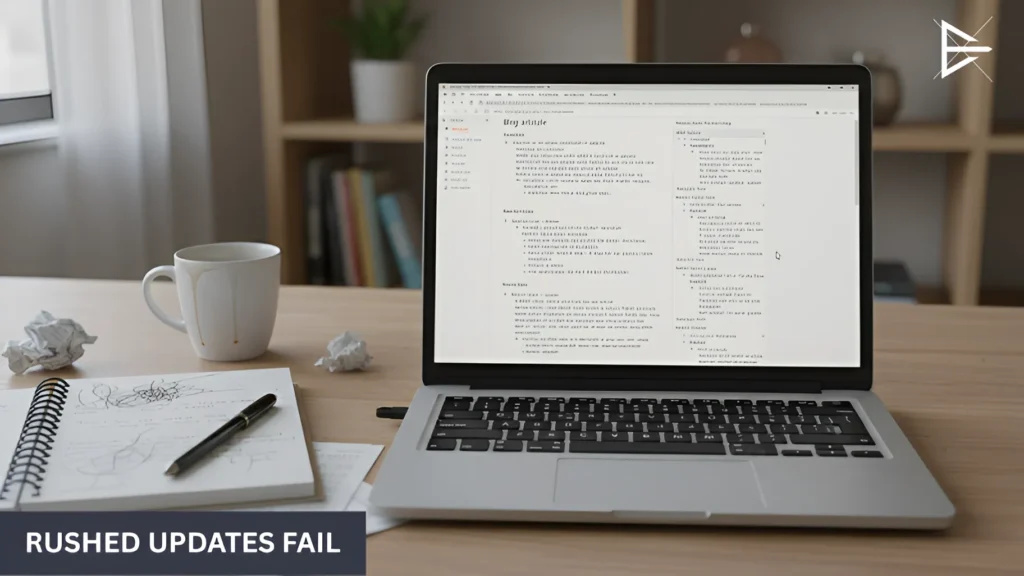
Laptop with a cluttered blog draft and scattered notes on a desk, representing rushed content updates that hurt SEO performance

Most ranking drops after updates happen for one reason. People change things without knowing what mattered before.

● Only changing the date

Changing the date alone does not fix anything. If the page still says the same things in the same way, search engines see no real improvement.

● Adding too many keywords

Trying to force words into the page usually backfires. The content becomes awkward, harder to read, and less useful.

● Deleting parts that already worked

Some sections bring traffic even if the rest of the page does not. Removing those parts can cause rankings to fall fast.

● Making changes without checking search data

Updating a page without looking at search data is guessing. You might remove the exact part people were finding useful.

How I Can Help You Improve Rankings by Updating Your Existing Content

Laptop displaying a blog optimization guide on a clean desk, showing a strategic approach to updating content for better rankings

When I update content, I do not guess. I look at what is already there and decide what is worth touching.

I look at what the page already does well. Some posts already get traffic or show up in search. Those are the ones I start with.

● I focus on small changes that actually help. Not every page needs a full rewrite. Often, a few fixes are enough.

● I match the page to how people search now. The topic may stay the same, but the way people search changes. The content should
match that.

● I clean up the page so it is easier to read. Clear sections, clear flow, and a clear next step matter more than extra words.

● I avoid breaking what already works. If a part of the page performs well, it stays. Updates should improve a page, not reset it.

Final Thoughts

Updating old blog posts is often one of the easiest ways to improve SEO. You are working with pages that already exist, already rank, or already get seen.

What matters is how the update is done. Changes based on real data usually work better than changes made by guesswork. Knowing what to fix and what to leave alone makes a big difference.

In many cases, improving an old post brings results faster than writing something new. That is why content updates are worth doing, especially when time or resources are limited.

Frequently Asked Questions

Does updating old blog posts really help SEO rankings?

Yes, updating old blog posts can help SEO rankings when the update makes the page more useful than before. Search engines want pages that clearly answer questions, stay accurate, and feel helpful to real people. When an update improves those things, rankings often follow.

This works best for posts that already exist in search results. If a page already shows up but struggles to move higher, fixing weak parts can give it a second chance instead of starting from zero.

Is changing the publish date enough to improve rankings?

No, changing the publish date alone usually does not improve rankings. If the words, structure, and meaning of the page stay the same, there is no real reason for search engines to treat it differently.

A date change only matters when real updates happen at the same time. Without meaningful improvements, changing the date can even make the page look misleading rather than helpful.

How often should old blog posts be updated?

There is no fixed rule for how often posts should be updated. Some posts stay accurate for years, while others need updates much sooner because information changes.

A better approach is to update when there is a reason. This could be falling traffic, outdated details, or changes in how people search. Updates should solve a problem, not follow a schedule.

Is it better to update old posts or write new ones?

Updating old posts is often the faster option because the page already exists and may already rank. Even small improvements can sometimes lead to noticeable gains.

New content is still important, but updates often bring results sooner. Many sites see the best results when they balance both instead of choosing only one.

How long does it take to see results after updating content?

Some updates show results in a few weeks, especially if the page already ranks close to page one. Other updates may take months, depending on competition and topic.

Results also depend on how strong the changes are. Small fixes bring small gains, while deeper improvements may take longer but have a bigger impact.

Can updating content hurt my rankings?

Yes, updating content can hurt rankings if the wrong changes are made. Removing strong sections or changing the main focus can confuse search engines and readers.

This is why careful updates matter. The goal is to fix weak areas while protecting the parts that already perform well.

What type of content benefits most from updates?

Content that already gets impressions, clicks, or some rankings benefits the most from updates. These pages are already visible and just need improvement.

Pages that never appear in search often need more than light updates. Those usually require a new approach or a different topic entirely.

Should I update every old blog post?

No, updating every old blog post is rarely a good use of time. Some content no longer fits your audience, your goals, or current searches.

It is better to focus on posts with clear potential. Updating fewer posts well often beats updating everything poorly.

Do I need to rewrite the whole article to see results?

In many cases, a full rewrite is not needed. Many posts improve with better structure, clearer wording, or updated information.

A full rewrite makes sense only when the page no longer matches what people search for. If the core idea still works, smaller updates are usually safer and faster.

What is the biggest mistake people make when updating content?

The biggest mistake is making changes without knowing what already works. This often leads to removing strong sections by accident.

Looking at performance before updating helps avoid this problem. Good updates protect what already brings value and fix only what needs fixing.

Does updating content help with click-through rates?

Yes, updating content can help improve click-through rates when the page looks clearer and more helpful in search results. Titles and descriptions that explain the page better make it easier for people to choose your result.

This matters most for pages that already show up in search but do not get many clicks. Even small wording changes can make the page feel more relevant and worth opening.

Should I change the URL when updating a blog post?

In most cases, you should not change the URL when updating a blog post. URLs often already have value from links, bookmarks, and past rankings.

Changing a URL without proper redirects can cause traffic loss. Unless there is a strong reason, it is safer to keep the URL the same and update the content instead.

How do I know which sections of a post to leave alone?

Sections that already bring traffic or rank for certain searches should usually stay untouched. These parts already match what people are looking for.

Checking performance data helps show which sections matter. Protecting these areas prevents accidental drops while other parts are improved.

Do internal links matter when updating old content?

Yes, internal links matter a lot when updating old content. They help readers move to related pages and spend more time on the site.

They also help search engines understand how your content fits together. Updating links can strengthen both the page and the site as a whole.

Can content updates replace an SEO strategy?

No, content updates cannot replace a full SEO strategy on their own. They work best as one part of a larger plan.

Updates support SEO by improving existing pages, but other work like tracking, structure, and planning still matters for long-term results.

Should I update content even if it still ranks well?

Only update content that ranks well if something is clearly outdated or confusing. Making changes just for the sake of it can cause harm.

Strong pages should be handled carefully. Small, focused improvements are safer than major changes when rankings are already good.

Do content updates work for all industries?

Yes, content updates work across many industries, but how often they are needed can vary. Some fields change quickly, while others stay stable.

The key is timing. Updates work best when they reflect real changes in information or user needs, not just routine edits.

Is it risky to update high-performing blog posts?

It can be risky to update high-performing blog posts if the changes are too large or rushed. These pages already perform well and have more to lose.

That is why updates on strong pages should be limited. Small improvements are safer and easier to control.

How do I know if an update actually helped?

The best way to know is to compare performance before and after the update. Look at changes in impressions, clicks, rankings, and user behavior.

Results do not always show right away. Tracking over several weeks gives a clearer and more reliable picture.

When should I get help updating blog content?

You should consider getting help when you are unsure what to change or worried about breaking rankings. Updates done without a plan can cause problems.

Getting help often saves time and reduces risk. It also helps make sure updates are based on real data instead of guesswork.


About the Author

Harvie Ken Colonia

Hi, I’m Harvie!

I started working with SEO in 2019. Back then, I noticed something early on. Most websites didn’t need more blog posts. They needed better versions of the ones they already had.

Over time, I saw the same pattern again and again. Old posts would slowly lose traffic, not because the topic stopped working, but because the content was never updated. Fixing those pages often brought results faster than publishing something new.

This article is based on that experience. It shows how small, careful updates can make a real difference, especially when you focus on what already works instead of starting over every time. If you’re unsure which posts are worth updating or what to fix without hurting rankings, I’m happy to take a look.