Small Business SEO Basics

How Many Pages Does a Small Business Website Need to Rank?

Find out whether you need more pages or just better ones to rank on Google.


The Short Answer (For Busy Business Owners)

Most small business websites can rank on Google with about 5 to 10 pages.

That may sound low, but it is true. Many small businesses rank with sites that size every day. You do not need a large website just to be taken seriously by Google.

What matters more is what each page is about and whether it helps the person searching. A page should answer a clear question or explain a clear service. If it does not, it usually does not help your rankings.

A smaller site with clear service pages often performs better than a bigger site filled with extra pages that overlap or never get traffic.

What You’ll Learn in This Guide

Why Page Count Alone Does Not Determine Rankings

Laptop showing a single focused content page beside stacked papers, representing how focused pages outperform scattered content

Google does not rank entire websites. It ranks pages. Each page stands on its own and is judged by how well it fits a search. That is why a small site with a few solid pages can outrank a much larger site that is spread thin.

When Google looks at a page, it cares about a few basic things.

● Does the page line up with the search?

If someone searches for a specific service, Google wants a page that clearly talks about that service. Not a general page. Not a mixed page. A clear one. Pages that try to cover too many topics usually do not rank well.

● Is it obvious what the page is about?

A visitor should not have to scroll or guess. Within a few seconds, they should know what the page offers. If people land on a page and feel unsure, they leave. That tells Google the page is not a good match.

● Does the page actually explain things clearly?

Strong pages answer common questions and explain the service in plain language. They do not try to sound impressive. They try to be useful. Pages that feel vague or incomplete rarely hold rankings for long.

● Is there a clear next step?

Good pages guide people. Call. Book. Learn more. When visitors know what to do next, they stay longer and interact more. Google notices that behavior.

The Core Pages Every Small Business Website Needs

Laptop displaying a streamlined business homepage and services section, showing a website built with only essential pages

Most small business websites do not fail because they are missing pages. They fail because the pages they do have are unclear or trying to do too much.

You do not need many pages to start. You need a few pages that each do one job well.

● Homepage

Your homepage sets the scene. It should quickly tell people what you do, who you help, and where you operate. Its job is not to rank for every service. Its job is to point visitors in the right direction.

● Service pages

These matter more than anything else. Each main service should have its own page that clearly explains what you offer and how someone can get started. If a service makes you money, it deserves its own page.

● About page

People check this page more than you might think. They want to know who they are dealing with. This does not need to be a long story. Clear, honest, and simple works best.

● Contact page

This page should remove friction. Phone number. Form. Location if relevant. Nothing fancy. If it is hard to reach you, many visitors will not try twice.

● Optional blog or resource page

A blog can help, but only if it has a purpose. Many small businesses rank just fine without one. If you do use a blog, it should support your services, not exist just to post content.

Pages You Probably Do Not Need at the Start

Laptop surrounded by stacks of printed pages, symbolizing website clutter caused by too many unnecessary pages

A lot of small business websites get heavy too early. Not because the business is big, but because pages were added before there was a real reason for them.

This usually shows up in a few ways.

● Overbuilt service sub-pages

It is common to see five or ten pages that all describe the same service, just worded slightly differently. Early on, this does not help. It splits attention and makes it harder for any one page to rank. One clear service page almost always works better than several similar ones.

● Low-value mission or team pages

Many sites launch with long mission statements or full team sections right away. These pages rarely bring traffic and rarely help someone decide to contact you. They can be useful later, but they are not a priority at the start.

● Pages created just to make the site look bigger

Some pages exist only so the website feels larger or more complete. They get no visits and serve no clear purpose. Over time, they just add clutter and make the site harder to manage.

How Many Pages Is Ideal for Most Small Businesses?

Small business website open on a laptop with a simple page structure, illustrating the right number of pages for growth

There is no perfect number, but there is a range that works for most small businesses.

For many, it looks like this.

● About 5 pages

This is the minimum that usually works. A homepage, a main service page, an about page, and a contact page. Some businesses add one extra page for basic info. For simple services, this can be enough to get started.

● Around 6 to 10 pages

This is where most small business sites end up. It gives you room to explain your services more clearly without making the site too big. For local businesses, this range often works very well.

● More than 10 pages

Once you pass ten pages, there should be a clear reason. More services, more locations, or a real content plan. If pages are added without a plan, they usually do not help much.

Quality Over Quantity (Why Fewer Strong Pages Win)

Focused service page shown on a laptop screen in a minimal office setting, emphasizing quality content over too many pages

More pages do not automatically help a website.

In fact, many small business sites struggle because they have too many pages saying almost the same thing. When that happens, none of the pages stand out. They end up competing with each other.

A single, clear page usually works better.

When one page focuses on one service and explains it well, Google knows what to do with it. Visitors do too. They stay longer, they read more, and they are more likely to reach out.

How pages are connected also matters. Important pages should be easy to find. Service pages should not be buried or hidden behind too many clicks. A simple structure helps people move through the site without thinking.

When Adding More Pages Actually Helps SEO

Laptop displaying organized service pages on a business website, representing intentional page creation that supports growth

Adding more pages can help, but only in certain situations. Most of the time, it works best when something in the business has actually changed.

For example.

● When you offer more than one real service

If people search for your services separately, those services should not all live on one page. Giving each main service its own page makes it easier for Google to match the page to the search. It also makes it easier for visitors to know they are in the right place.

● When you work in more than one area

If you serve different cities or regions, separate pages can help each area show up in search. These pages need to feel real and specific. If they all say the same thing, they usually do not work.

● When people are already looking for it

New pages perform best when there is clear interest. This often shows up in customer questions, search data, or patterns you notice over time. Pages built around real demand tend to earn traffic. Pages built on guesses usually do not.

● When there is a plan behind it

Pages work better when they are added with intention. Each page should have a reason to exist and a clear place in the site. Random pages added here and there often end up ignored.

Common Mistakes That Prevent Websites from Ranking

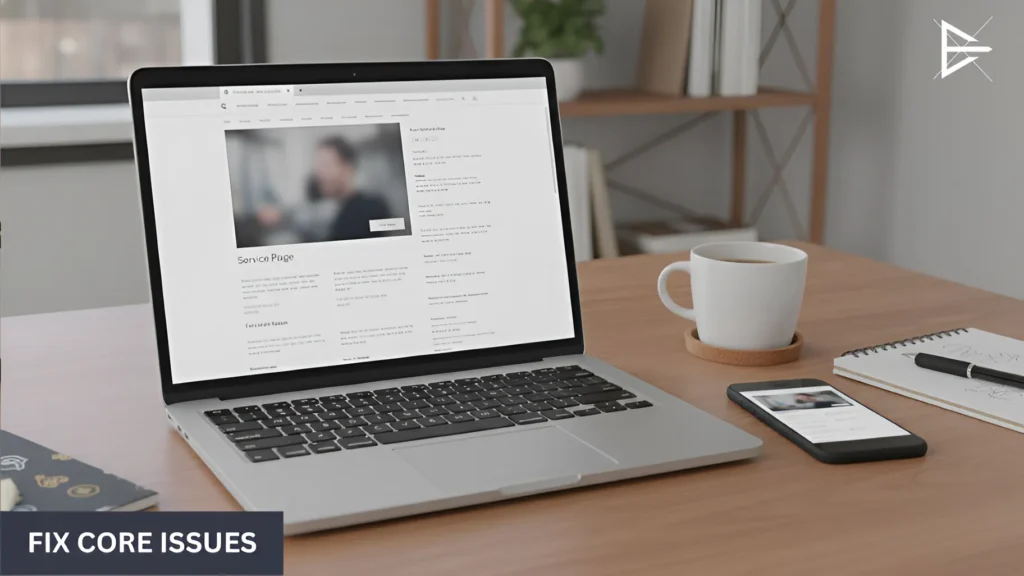
Small business website open on a laptop with a phone beside it, showing the process of fixing core usability and content issues

Most websites do not break because of one big mistake. They stall because of a few small ones that never get attention.

These are the ones that show up again and again.

● Pages that say very little

Some pages exist, but barely. A short intro, a few vague lines, and that’s it. These pages do not help visitors and they do not give Google much to work with. When a page feels unfinished, it usually performs that way too.

● Sites that are hard to move through

If people have to hunt for services or guess where to click next, they leave. Important pages should be easy to find. When the site feels messy or confusing, rankings usually follow.

● No clear next step

This happens a lot. A page explains a service but never asks the visitor to do anything. No call. No form. No direction. When people are unsure what to do next, they often do nothing.

● Slow or awkward mobile experience

Most visitors are on their phones. If a site loads slowly or feels clunky on mobile, people bounce fast. Even good content struggles when the experience is frustrating.

How I Can Help You Decide What Your Website Actually Needs

Laptop on a clean office desk displaying a website layout being reviewed for structure and clarity before making changes

Most people I work with are not stuck because they lack information.

They are stuck because everything feels unclear at the same time.

This is what I usually hear:

● “My website is live, but nothing is happening.” It exists. People visit. But it does not turn into calls, emails, or leads.

● “I don’t know if I need more pages or just better ones.” Some pages feel thin. Others feel ignored. It is hard to know what actually matters.

● “I don’t know which pages are helping or hurting.” Everything feels important, so nothing gets priority.

“I just want to know what to fix first.” Not a long plan. Just a clear starting point.

This is how I approach it:

● I start with what is already there. No rebuilding for the sake of it. No assumptions.

● I look at what each page is really doing. Some pages try to do too much. Others do nothing at all.

● I spot overlap fast. When pages fight each other, rankings stall.

● I focus on real searches, not guesses. What people actually type matters more than what sounds good.

● I separate what matters now from what can wait. That alone removes most of the stress.

Where to Go From Here

Most small business websites do not struggle because they are too small.
They struggle because the pages they have are unclear or pulling in different directions.

You do not need dozens of pages to rank. You need a few pages that are clear, focused, and easy to understand. When those pages do their job, everything else gets easier.

If your website feels stuck and you are not sure why, the first step is not adding more content. It is figuring out what already exists, what is working, and what is getting in the way.

Frequently Asked Questions

How many pages does a small business website really need to rank?

Most small business websites can rank with about 5 to 10 pages if those pages are clear, focused, and useful. Google does not expect a small business to have a large website. It looks for pages that answer real searches and explain real services.

A website with fewer pages can still perform very well when each page has a clear purpose. When pages are specific and easy to understand, Google has an easier time matching them to searches. That clarity matters more than size.

Can a 5-page website rank on Google?

Yes, a 5-page website can rank on Google, and many small businesses do exactly that. A basic setup usually includes a homepage, one main service page, an about page, and a contact page, with one extra page if needed.

What makes the difference is not the number of pages, but how well they are written. If each page clearly explains what you offer and who it is for, a small site can compete with much larger ones.

Does having more pages automatically improve SEO?

No, adding more pages does not automatically improve SEO. Pages only help when they exist for a clear reason and are built around something people are actually searching for.

Extra pages that repeat the same ideas or target the same keywords often weaken a site. Instead of helping, they can cause confusion for both visitors and search engines.

Is it better to have fewer strong pages or many average pages?

It is usually better to have fewer strong pages than many average ones. Strong pages stay focused on one topic and explain it clearly, which helps them rank and convert better.

When a site has many average pages, those pages often overlap or compete with each other. This makes it harder for any one page to stand out in search results.

What pages matter most for SEO on a small business website?

Service pages matter the most because they match what people are searching for when they want to hire or buy. These pages explain what you offer and are often the main source of leads.

The homepage, about page, and contact page support those service pages. Together, these core pages give Google and visitors enough information to trust the site and take action.

Do I need a blog to rank my website?

No, a blog is not required for a small business website to rank on Google. Many businesses rank using only their core pages, especially strong service pages that clearly explain what they offer. Google does not expect every business to publish content regularly.

A blog can help when it is used the right way. It works best when posts answer common questions, explain services in more detail, or support your main pages. A blog that exists just to add content, without a clear purpose, usually does not help rankings or leads.

Why do some small websites outrank larger ones?

Small websites often outrank larger ones because their pages are more focused. Google ranks individual pages, not the size of the site. When a page clearly matches a search and explains the topic well, it can rank even if the site is small.

Larger websites sometimes struggle because they have too many pages saying similar things. When pages overlap or compete, Google has a harder time deciding which one to rank. Clear, simple sites often win because they are easier to understand.

Should each service have its own page?

In most cases, yes. If people search for your services separately, each main service should usually have its own page. This makes it easier for Google to match a page to a specific search and show it in results.

Service pages also help visitors. When someone lands on a page that matches exactly what they are looking for, they are more likely to stay, read, and contact you. Clear service pages often perform better than one long page listing everything.

Is it bad to have pages that are very similar?

Yes, very similar pages can cause problems. When multiple pages cover the same topic in almost the same way, they often compete with each other. This can lower rankings instead of improving them.

In many cases, similar pages should be combined into one stronger page. A single clear page usually performs better than several weaker ones that overlap and confuse both visitors and search engines.

When does adding more pages start to make sense?

Adding more pages makes sense when there is a clear reason behind it. This often happens when a business adds new services, expands into new areas, or sees real search demand for specific topics.

Pages added without a plan usually do not perform well. When new pages are created with purpose and fit into the overall site structure, they are more likely to rank and bring value.

Do location pages help with local SEO?

Location pages can help with local SEO when they are done the right way. If your business serves different cities or areas, a page that focuses on each location can help Google understand where you work and who you serve.

The key is that these pages need to feel real. Simply copying the same content and changing the city name rarely works. Location pages should mention services, context, and details that actually apply to that area so they provide real value.

What is thin content?

Thin content is a page that exists but does not say much. It may be very short, vague, or missing important details that a visitor would expect to see.

Pages like this are hard for Google to rank and hard for visitors to trust. Strengthening thin pages or combining them with other pages often improves both rankings and user experience.

Can too many pages slow down SEO progress?

Yes, having too many low-value pages can slow down SEO progress. When a site has many pages that do not perform well, it becomes harder for Google to understand what the site is really about.

Too many weak pages can also make a site harder to manage. Cleaning up unnecessary pages often leads to better focus, stronger rankings, and clearer results over time.

Does site structure matter more than page count?

Yes, site structure often matters more than how many pages you have. A clear structure helps visitors find important pages quickly and helps search engines understand how pages relate to each other.

When structure is messy, even good content can struggle. Important pages should be easy to reach, and related pages should connect in a way that makes sense.

Why is my website getting traffic but no leads?

This usually happens when visitors do not know what to do next. The page may get traffic, but the message is unclear or the service is not explained well enough.

Weak calls to action can also cause this problem. Clear service explanations and simple next steps often turn traffic into real inquiries more effectively than adding more visitors.

How important is mobile performance for rankings?

Mobile performance is very important for rankings because most people visit websites on their phones. Google looks closely at how a site works on mobile, not just how it looks on a desktop screen.

If a site loads slowly or feels hard to use on a phone, visitors leave quickly. Even strong content can struggle to rank when the mobile experience is frustrating or broken.

Should I remove pages that are not performing?

Sometimes, yes. Pages that get no traffic, serve no clear purpose, or overlap heavily with other pages can often be removed or combined.

Cleaning up pages helps focus attention on what matters. Fewer pages that are clear and useful usually perform better than many pages that do very little.

Is it better to fix existing pages before adding new ones?

Yes, fixing existing pages is usually the better first step. Improving clarity, structure, and content often leads to faster results than creating new pages.

Adding new pages too early can spread effort thin. Strong foundations make future growth much easier and more effective.

How do I know which pages are helping or hurting my site?

Pages that help usually have a clear purpose and match real searches. Pages that hurt often feel vague, overlap with others, or confuse visitors.

Looking at traffic, engagement, and page focus often reveals problems quickly. Even without deep tools, unclear pages usually stand out.

What is the best first step if my website feels stuck?

The best first step is to review what you already have. Look for pages that are unclear, outdated, or trying to do too much at once.

Once you understand what is working and what is not, decisions become easier. Clarity almost always comes before growth.


About the Author

Harvie Ken Colonia

Hi, I’m Harvie!

I started working in SEO in 2019 after seeing how confusing websites can be for small business owners. Many sites look fine on the surface, but still struggle to rank or bring in leads.

Most of my work is about helping businesses understand what their website actually needs. That often means cleaning up pages, fixing overlap, and making sure each page has a clear purpose instead of adding more content.

If your website feels stuck and you are not sure what to fix first, you are not alone. Getting clarity on that usually makes the next steps much easier. Interested in improving your website? Let’s chat and see what actually makes sense for your business.